
The no-excuses lead gen engine
In a perfect world, you’d have the right amount of billable work every month. You’d know what’s next, cashflow would behave, and profitability would stay comfortably in the black.
But that world doesn’t exist – and it’s getting even less predictable.
So if you’re solo (or solo-plus), you need a simple lead gen system that gives you control and visibility. A system you can run even when you’re busy. A system that doesn’t feel like hustle.
Here are three steps to build it.
What is a lead pipeline?
Picture a water tank under your house.
Leads flow into the tank. A tap controls what comes out. The bucket you’re filling is your bank account.
When you can’t see the tank, you don’t know whether you’re fine… or two weeks away from panic. A lead pipeline makes the tank visible. It tracks potential work from ‘might happen’ to ‘done and invoiced’ – so you can top it up before it runs dry (or floods your life).
Step 1. Set up a system
It doesn’t matter if you use a CRM, Trello, Notion, your workflow platform, or a spreadsheet. What matters is that your leads are visible, measurable, and follow-up-able.
Make it visible
Every week you collect lead clues: intros, emails, LinkedIn messages, comments, ‘we should talk’ chats, ‘down the track’ hints.
Capture them the moment they appear, and tag:
temperature (hot / warm / cold)
value (rough guess – such as under $1k, $1–5k, $10k+)
If it’s not written down, it’s not a lead. It’s a wish.
Make it measurable
How many leads do you need ‘in the tank’? That depends on:
your income target
your average project value
your win rate (quotes that end in yes)
Here’s an example:
Win rate: 50 - 60%
Average project: $8,000
Target: $40,000 per quarter
A useful rule is 2x coverage with that win rate. So your pipeline should hold roughly $80,000 (about 10 projects) to convert 5 or 6 into work.
Make it easy to convert
Following up takes time, so build a small response toolkit you can reuse:
One-page PDF for cold leads and tyre kickers (who you are, proof points)
Proposal template (problem → approach → outcome → fees)
Pitch deck (for senior decision makers)
Recap email template (copy-paste text for next steps and responsibilities)
Reverse brief template (to get buy in on what you’re really solving)
Use your AI meeting recorder for faster clarity on the underlying problems and opportunities, as well as next steps.
Step 2. Proactively collect leads
Once the system exists, you’ll quickly see when the tank needs refilling. Here are seven proven ways to top it up:
1. Research calls with past or current clients (not a sales call)
Ask:
What are the 3 most important bets this year?
Where is your current [area] falling short?
If you could fix one thing overnight, what changes first?
What did you value most about our work? What would make it even better?
Listen for their exact words – then mirror that language in your follow-up.
2. Ask AI for lead lists (and use your judgment)
Use GPT/Claude to generate:
ideal client pain points
events and associations in your niche
LinkedIn groups and ‘people like this’
adjacent service providers you could partner with
3. Ask for referrals – explicitly
Put it in your invoice email, your footer, and your project wrap-up:
“If you know someone who needs X, I’d love an intro.”
4. Build a referral network
Find consultants, agencies and platforms solving adjacent problems for the same buyers. Co-create a webinar, event, or a useful guide.
5. Pitch industry media
Articles, op-eds, case studies, podcasts. Authority travels further than a cold DM.
6. Attend industry events
This is not about networking. It’s about like-minded conversations and slow burn relationship building.
7. Follow up the maybes
The projects you didn’t win. The ‘not yet’ leads. The brilliant idea someone mentioned months ago.
One big-ticket event a year landed me over $1million in ongoing work over several years. Not because I worked the room like a maniac. I wanted to learn, I was willing to share generously, and then I followed up.
Step 3. Build a regular rhythm
You have a system. You have tactics to fill the tank. But none of this will work unless you block out a few hours a week to DO IT.
Step 3 takes discipline – I’ve learned that the hard way. In the final years of my business, I prioritised any other task in my life over lead generation. Partly because I was scared of getting too busy – I still had PTSD over the times the lead tank did flood my life. And partly because I was complacent. In the past, leads had arrived as if by magic. Until they didn’t, and our tank got dangerously close to dry.
So don’t think of this as admin or even marketing. This is future revenue.
Weekly – gently simmer
Follow up warm and hot leads
Follow up upsell opportunities in current work
Make 2-3 targeted LinkedIn connection moves
Share something useful (not sales-y)
One coffee / walk / real conversation
Monthly - top up the tank
Send your eNews
Follow up a recent project
Ask for a testimonial or case study
Follow up cold leads
Check what’s working – measure and adjust
Quarterly - build real relationships
Attend an industry event
Meet a potential referral partner
Pitch industry media / podcast
Run a webinar or small event
Launch a lead magnet
Survey clients
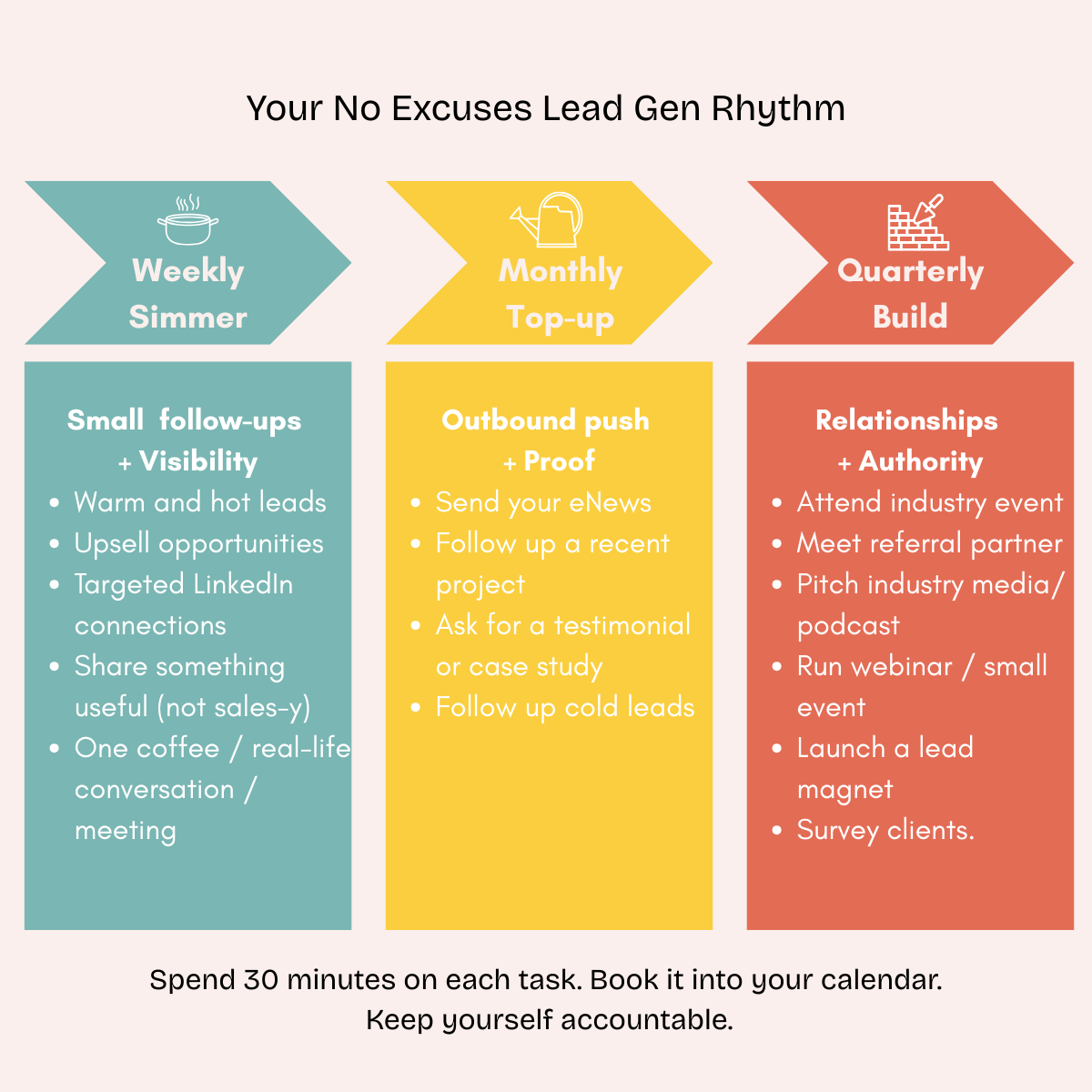
Lead generation habits graphic
Most of these are 30-minute tasks. Put them in your calendar like client work – because they are.
Ready to start? Write down the smallest step you can take today to make your pipeline visible… and do that. No drama. No excuses.
